The 5 pillars of good design leadership

What does leadership entail in the context of design? What does a lead product designer have to concentrate on in order to be a good design leader? How does an organization benefit from strong design leadership? And how do we establish ourselves as design leaders within external organizations here at UX studio?
As a ui/ux design agency, we're facing these questions every day. Hired as external consultants, researchers, and product designers, we're often asked to join an existing product team. This means that we're not only expected to hand over deliverables, but to help in transforming an organization from the inside as an embedded design team.
While a complicated process, we developed this 5-step guide for achieving meaningful and sustainable change for our clients and ship highly successful digital products by building up a user-centered mindset.
.png)
The 5 pillars of good design leadership
1. Listen first
Understanding the team and the context they operate in is the starting point before trying to change anything. A good design lead takes a deep look at how things are going at the moment and identifies what can be improved in collaboration with the team. Change must be gradual and informed.
2. Find purpose
The leader has to clearly identify the team's purpose and communicate the product vision. Good leaders are storytellers who can create narratives that can inspire every stakeholder involved.
3. Create alliances
The leader is responsible for being the voice of the team internally as well as externally. If the alignment is achieved in the organization and within the team, you will be able to build great things together.
4. Balance structure and flexibility
Recognize the potential in your team and trust them to be independent creative problem-solvers. Some structure is necessary, but make sure to provide enough freedom and flexibility, too. Product design is not like an assembly line. You are managing humans, not machines.
5. Adapt goals and monitor
Design leaders can identify countless opportunities to improve in an organization, but how should they prioritize? Taking the design maturity of your organization into account will give a great basis for understanding where to start and what direction to go. Also, we shouldn’t forget to look back often to monitor the completion of our goals.
Let’s see how these five pillars are established in our day-to-day practice here at UX studio.
Practicing what we preach
1. How we learned to listen
One of the first things every UX lead learns at UX studio is that there are no pre-packaged solutions to provide for clients. No two clients who are the same, so no two ways of leading should be the same, either.
Luckily, this is not at all foreign to us. The product design approach we follow is heavily focused on doing design based on knowledge and understanding. The three main contexts we have to listen to are: users, business -and technology, and everything in between.
When a project starts, we do a kickoff meeting to ensure we have a head start on all the necessary knowledge and materials we will need to begin rapidly progressing. Similarly, when someone gets in a leadership role, we usually start with running a survey inside the team and maybe with other stakeholders as well. These can serve as a starting point to having in-depth conversations with stakeholders to unearth as many insights as possible. All leads have weekly or biweekly 1:1s with every member of their team to open up communication; every 6 months, we have anonymous leadership evaulation surveys too, for better accountability.
.png)
2. How we find purpose
Good leads recognize that issues don't necessarily indicate a lack structure, but that the structures in place needs to be looked at critically. It may be the case that the purpose it was built on was not formulated in an understandable and motivating way.
A well-phrased goal or vision helps everyone in the team to think deeply about their role in relation to it. It also helps people outside the team understand the importance of our work so we can find more allies across the organisation.
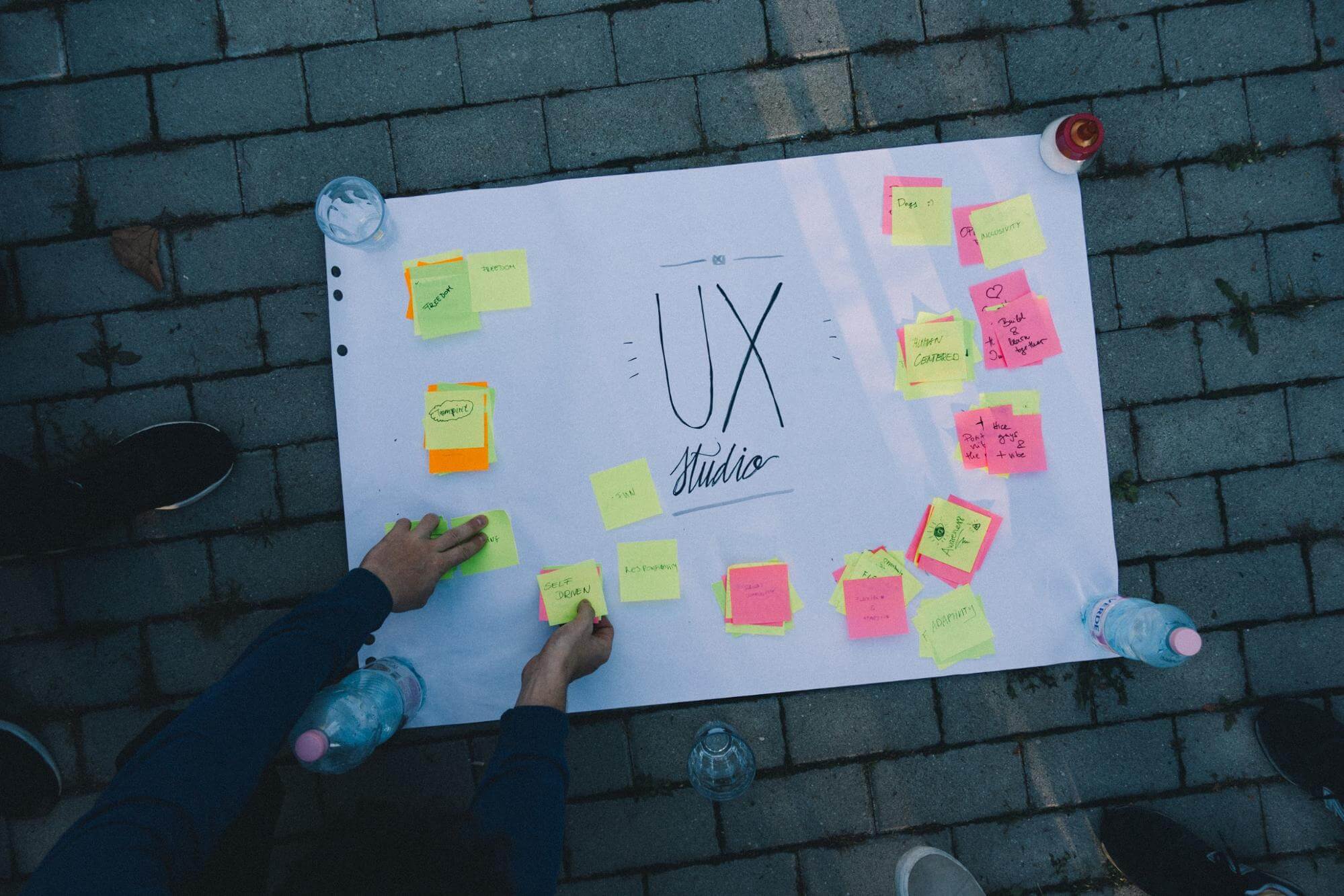
Every team at UX studio formulates their vision and goal together on our retreats, which is then pinned to our dedicated Slack channels as a motto. Objectives are also set as a group, making sure that our goals are meaningful, achievable and inspiring.
We can help bring purpose to client projects as well: we often hold value proposition and mission, vision and values workshops that are then revisited from time to time throughout projects. Read more about the first phase of the project in our case study.
3. How we create alliances with clients
In most companies that do product design, there's incredible intellectual potential that gets overlooked because of the lack of alignment about the goals and vision.
One of the essential responsibilities of a leader is to create a sense of shared purpose and understanding within their team. And product designers have a great perspective to do this. First of all, they are already in the cross-section of the user-business-technology triangle. Secondly, they are well equipped with visual and verbal communication as well as people skills.
Communicating our purposes is vital outside the team as well. If our goals are not clear or get misunderstood in the larger organization, it can be hard to achieve buy-in and gather the necessary resources for our team.
If you feel your team needs to acquire more significant influence over overarching structures, communicate and advertise your goals and achievements to as many stakeholders as possible. And make sure they understand the meaning of them. You might have to talk to departments outside product design, such as finance or accounting. Translate your thoughts so anyone can appreciate their meaning.
.png)
In a recent fin-tech project, we had a lot of struggle with a lead developer who didn’t seem to appreciate UX values and kept making changes to the design without our knowledge. Our team leader invested a lot of time into discussing these issues with the lead developer. She explained our process over and over again, showed important parts of usability test recordings and, found different ways to show the value we provide.
After a while, the developer started to appreciate all the energy and knowledge that goes into making our design decisions, and now he helps us communicate the benefits of design thinking and human-centred design to parts of their organization we didn’t even have access to before.
4. How we balance structure and flexibility
So here we are. We understand the context and people we have to manage. We are starting to create a shared sense of purpose. The team is aligned. Alliances are being built up. Time to build The Process... carefully.
Leaders often default to creating invincible structures and processes for their teams. The issue is whenthese management methods were developed a long time ago and for a very different working environment — namely factory assembly lines.
As this wonderful article by Intercom points out:
“...there are many jobs, like building cars, that still benefit from a scientific management approach. These are, however, the jobs that will most likely be automated out of existence in the coming years and fine-tuned to extract even more productivity gains. It turns out that treating humans like humans and machines like machines is a pretty good management approach.”
So instead of precisely determined processes and strict reward and punishment systems, we have to conceive something more empowering for the workplace of today.
Product development is hard. We have to ensure that all our team members have the opportunity to maximize their contribution. Our teams consist of smart and creative people who have to deal with unique situations all the time. The structure we implement has to reflect this.
We have to provide structure, tools, and guidelines to our team. And we have to design them in a way that incorporates the possibility of deviating from them.
Our agency is a team of 40, and we love to make decisions together. But after a certain number of participants, it can be harder to have fruitful conversations and make the right decisions.
What we did to solve this was not providing a complex process of bureaucracy or rulebook, instead, when we find necessary, we either divide ourselves into smaller groups or use tools that help to facilitate large group conversations from participatory democracy. We developed a shared vocabulary and voting processes that help to provide guidelines to ease group decision making.
5. How we adapt goals and monitor success
We have a very diverse set of clients. We find that one of the ways to understand what kind of framework they might benefit from the most is not just by looking at the industry they are in, but also by assessing their design maturity.
There are many models to help us understand the design maturity of an organization. Around 20 years ago, the Danish Design Centre developed the Design Ladder. Industry expert Jacob Nielsen developed another model in 2006, and countless others have written about this subject. The Invision’s Maturity Model is based on a 2018 survey of designers from more than 2,200 organizations around the globe to understand how design maturity relates to business performance. While doing so, they discovered five stages most businesses can be grouped into.
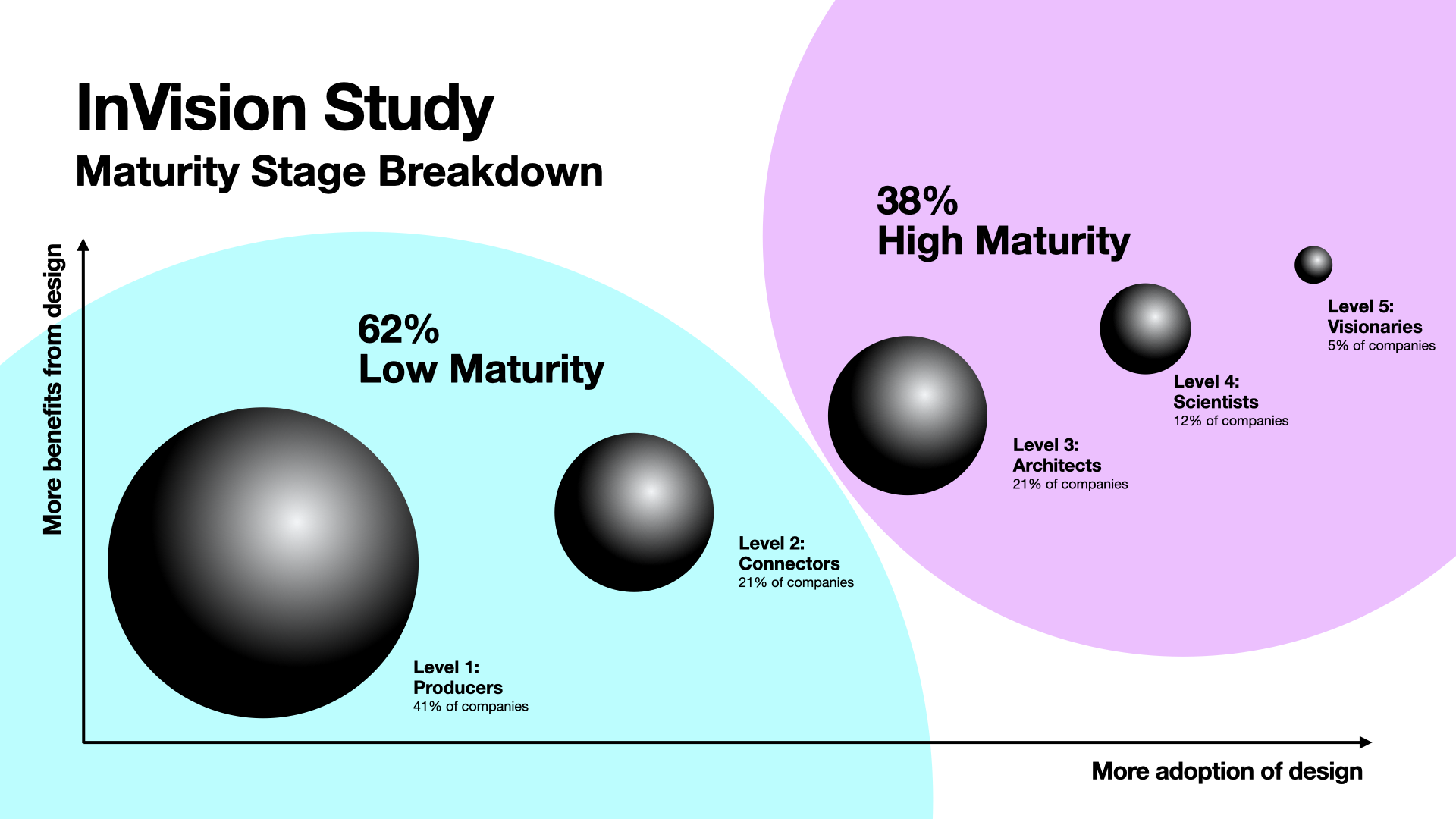
The Invision Maturity Model understands that a huge part of design happens outside of designers’ influence and looks at the organization from a holistic design perspective.
The stages it describes can serve as narrative tools to inspire design leaders in creating inspiring stories for their team about where they came from and where they want to go.
The position we put ourselves in is always one that places a great emphasis on nurturing culture. We strive to create meaningful and lasting change, and for that, you have to go step by step, making sure that all the essential habits in the processes we implement get adapted by everyone in the team before we move on.
Conclusion
As with any other skills leadership is also cultivated through trial and error, and that needs a certain kind of bravery and determination. Especially since the fact that other humans are going to be profoundly affected by decisions made by leaders. Responsibility is key, and in our experience, it is so much better when the motivation to lead doesn’t come from a place of ego but responsibility and hard work.
When you find yourself in a leadership position, make sure to take responsibility for your decisions, lead by example, and empower others to do so as well.
Searching for the right UX agency?
UX studio is UX/UI research and design agency for B2B vertical SaaS teams, with 10+ years of experience and our own digital product line.
Whether you're scaling fast or need extra hands on deck, our subscription-based model gives you a fully dedicated and embedded UX/UI team that feels like your own.
Need a partner, not just an agency?
- Check out our case studies
- Get in touch with us directly
Credits
This blog post was written by Katie Somos, product designer
Updated and edited by Dr. Johanna Székelyhidi, marketingmanager